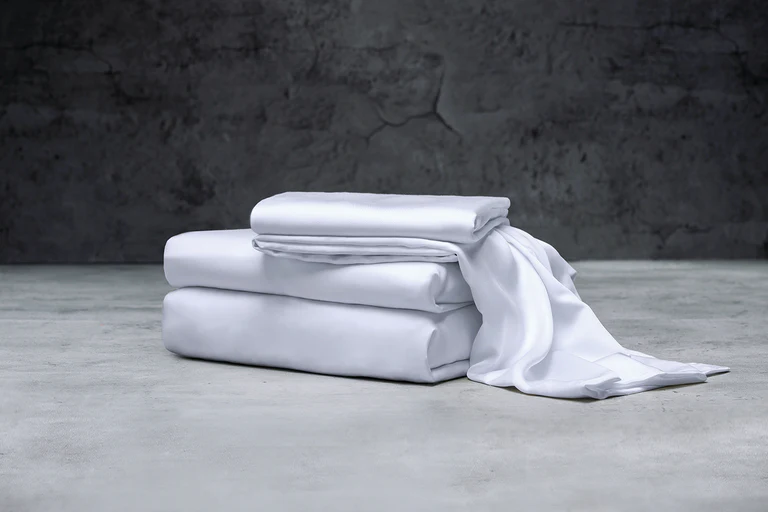
A regional bedding retailer we know ran a simple spring promotion: a “Complete White Bed” bundle — fitted sheet, flat sheet, two pillowcases, a duvet cover, and a mattress protector, one price, one box. The sheets came from wholesaler A, the duvet cover from wholesaler B, and the protector from wholesaler C. All three swore their white was “standard optic white.” Under the store’s display lighting, the bundle contained three visibly different whites. Customers noticed. Returns ran at triple the retailer’s normal rate, the bundle was pulled after five weeks, and the buyer spent the rest of the quarter explaining to her director why “white” is not a color — it is a coordination problem.
This is the hidden tax of multi-vendor sheet programs. Nobody chose wrong on price; every line item was competitive. What nobody owned was the system: the shade continuity across categories, the single quality standard, the one purchase order that ties a program together. That is the case for one-stop sourcing with bed sheet wholesalers — not as a convenience slogan, but as a measurable commercial strategy. Consolidating your sheet program with one wholesaler who can deliver sheets, pillowcases, duvet covers, and protectors under one PO changes the math on quality, logistics, and accountability. This article makes that case honestly: where one-stop wins, where it does not, and how to evaluate whether your program is ready for it.
What “One-Stop” Actually Means in Bedding
One-stop sourcing is often misunderstood as “buy everything from one place because it is easier.” The real definition is stricter: a single accountable partner who controls the full product system — greige sourcing or weaving, dyeing and finishing to one shade standard, cut-and-sew across all categories, one QC protocol, and one consolidated shipment. The operative word is controls. A trading company that subcontracts your sheets to mill A, your duvet covers to factory B, and your protectors to factory C is not one-stop sourcing; it is multi-vendor sourcing with a single invoice. The coordination problems do not disappear — they just become invisible to you until the container arrives.
True one-stop wholesalers in bedding are typically vertically integrated manufacturers or manufacturer-direct wholesalers: they dye all your categories in the same dyehouse, against the same sealed shade standard, and sew them under one roof or one managed production system. That structural fact is what makes everything below possible. When you evaluate bed sheet wholesalers for a consolidated program, your first question should not be about price — it should be: “Which of my categories do you produce in-house, and which do you subcontract?” The answer draws the real boundary of the one-stop promise.
The Shade-Matching Dividend: One Dyehouse, One White
Bedding is sold as sets and bundles, which means it is judged as a system. A fitted sheet and a duvet cover that are each perfectly acceptable alone can fail together if their whites differ by half a shade. Shade continuity across categories is the single biggest quality dividend of one-stop sourcing, and it is nearly impossible to achieve across vendors. Dyehouses calibrate to their own chemistry, water, and machinery; “optic white” from two dyehouses is two different whites with the same name.
With one wholesaler dyeing your sheeting, your duvet-cover fabric, and your pillowcase fabric in the same facility against one sealed standard, cross-category matching becomes a controlled process instead of a hope. The lab-dip approval covers the whole program, the bulk production runs reference the same standard swatch, and the QC team compares categories against each other — not just against a paper tolerance. For programs built on white, ivory, or any pale shade, where the human eye is merciless, this alone can justify consolidation. Work with a vertically integrated producer like INTEGRITY TEXTILE, and your sage fitted sheet, sage duvet cover, and sage pillowcases are cut from production dyed to one standard — because the alternative is exactly the three-whites fiasco our retailer friend lived through.
One PO, One QC Standard, One Throat to Choke
Multi-vendor programs fragment accountability in ways that only become visible during a claim. The sheet wholesaler blames the duvet-cover factory’s finishing; the duvet-cover factory blames your shade standard; you end up arbitrating a technical dispute between two suppliers who have no contractual relationship with each other. With one wholesaler holding the entire program, accountability is structural: one purchase order, one set of specifications, one QC protocol applied identically to every category, and one party responsible when something fails.
The operational savings are concrete. One PO means one round of order confirmation, one production schedule to track, one pre-shipment inspection covering all categories, and one commercial invoice. Your QC cost per program drops because the inspector visits one facility, not three. Your communication overhead collapses: no more reconciling three different answers to “when does bulk start?” And when a problem does occur — a shading issue, a short shipment — there is exactly one phone call to make, to a partner whose entire relationship with you is on the line. Nantong Integrity Textile runs consolidated bedding programs this way by design: sheet sets, duvet cover sets, quilted bedding, and pillows specified once, inspected once, and shipped once, under a single accountable production plan backed by ISO9001-governed quality management.
The Consolidated Shipping Math Nobody Shows You
Here is where one-stop sourcing pays for itself in hard numbers. Three vendors mean three shipments — or, more commonly, three LCL consolidations routed through a forwarder, each with its own handling, documentation, and scheduling friction. One wholesaler shipping your full program means one FCL, stuffed once, with your categories loaded in the sequence your warehouse wants to receive them. The freight saving is real but it is not even the main prize. The main prize is the elimination of partial-program risk: the all-too-common disaster where the sheets arrive in March, the duvet covers in April, and your “complete bed” promotion launches with half its SKUs.
There is also a subtler inventory benefit. When one partner produces your whole program, production can be sequenced so that categories complete together, and safety stock can be planned at the program level rather than per vendor. Reorder math simplifies dramatically: instead of tracking three vendors’ lead times and minimums, you manage one replenishment relationship. For growing brands and retailers, this is often the difference between a program that scales smoothly and one that drowns its buyer in spreadsheets. The math deserves its own line in your landed-cost model: compare the true cost of three POs — three inspections, three freight bookings, three rounds of claims risk — against one. Most buyers who run the numbers honestly are surprised.
When One-Stop Beats Multi-Vendor — and When It Does Not
Intellectual honesty requires the other side of the case. One-stop sourcing wins when your program values coordination over category-level optimization: matching sets and bundles, pale and exacting colorways, tight launch calendars, and lean buying teams. It wins when your categories share fiber and construction — long-staple cotton sheeting across sheets, duvets, and pillowcases is the textbook case — because one dyehouse and one sewing operation genuinely serve all of them well.
Multi-vendor sourcing still wins in specific situations. If one of your categories is highly specialized — say, a waterproof mattress protector with a TPU membrane, or a down-alternative duvet insert with specific fill machinery — a dedicated specialist factory may outperform a generalist, and forcing it into a one-stop program can degrade that category. It also wins when your volumes per category are large enough that category-level price optimization outweighs coordination costs, or when supply-chain resilience demands dual sourcing for risk management. The sophisticated move is not “always consolidate” — it is consolidating the coordinated core of your program (sheets, pillowcases, duvet covers in matching shades) with one wholesaler while keeping truly specialized categories with specialists. Ask your candidate wholesaler directly which categories they genuinely manufacture versus source; at our factory, sheet sets, duvet cover sets, quilted bedding, fabrics, hotel linen, blankets, and pillows are all in-house production — roughly 143 people across 30,000 square meters, with monthly capacity around 40,000 bedding sets and 25,000 duvet cover sets — so the boundary of the one-stop promise is drawn honestly, not aspirationally.
How to Evaluate a One-Stop Wholesaler: The Five Tests
Not every wholesaler claiming “one-stop” can deliver it. Run these five tests before consolidating. First, the facility test: can they show you — by video call or visit — the dyeing, weaving or knitting, and sewing operations that will touch your program? Second, the shade test: ask how they guarantee cross-category shade matching, and require the answer to reference a sealed physical standard, not a Pantone number alone. Third, the capacity test: is your program’s monthly volume a comfortable fraction of their capacity, or will you be fighting their other customers for dyehouse slots? Fourth, the systems test: one PO, one QC report format, one shipping document set — ask to see samples of each. Fifth, the commercial test: a wholesaler confident in consolidation will discuss your target price openly. Our factory’s respect target price model — you name one price, we answer yes or no — was built for exactly this conversation: consolidating only makes sense if the consolidated price beats the fragmented alternative, and we would rather tell you honestly when it does not.
A Worked Example: Consolidating a 28-SKU Sheet Program
Consider a mid-size bedding brand running four colorways — white, ivory, sage, and slate — across seven items: fitted sheet, flat sheet, standard pillowcase pair, king pillowcase pair, queen duvet cover, king duvet cover, and a mattress protector. That is 28 SKUs. In the fragmented setup, the sheets and pillowcases come from wholesaler A, the duvet covers from wholesaler B, and the protector from wholesaler C. Every reorder cycle means three purchase orders, three production schedules to chase, three pre-shipment inspections at roughly $300 per visit, three freight bookings, and three separate shade standards that were each “approved” in isolation. The brand’s buyer spends an estimated two full working days per cycle just reconciling the three vendors’ timelines — and still absorbs the shade-mismatch risk every time white is reordered.
Consolidated, the same 28 SKUs become one purchase order with one line per SKU, one production plan sequenced so all categories of a colorway dye and sew together, one inspection visit, and one container. The direct savings are easy to itemize: two fewer inspection visits per cycle, two fewer freight handlings, and the elimination of the timeline-reconciliation work. But the strategic saving is bigger: the brand’s combined volume across all 28 SKUs now clears program-level minimums that no single category could reach alone, which earns priority dyehouse scheduling and sharper per-unit pricing. The buyer’s job changes from herding three vendors to managing one relationship against one specification pack — and the specification pack, once written, is reused every cycle instead of renegotiated three times.
How Cross-Category Lot Matching Actually Works
Shade matching across categories is not luck; it is a production sequence. In a consolidated program, the dyehouse dyes all fabric for one colorway in a planned campaign: the sheeting, the duvet-cover fabric, and the pillowcase fabric go through the same machines, against the same sealed lab-dip standard, within the same production window. Because dye chemistry drifts slightly from batch to batch even under perfect control, professional mills practice shade banding — grouping production lots into narrow shade bands and keeping each customer program within a single band. Your white fitted sheets and your white duvet covers are not merely “the same color recipe”; they are cut from lots verified to sit in the same band.
The verification happens at two points. First, at the lab stage: strike-offs or lab dips are approved per category but evaluated side by side, so the buyer signs off on the system of shades, not just individual swatches. Second, at final inspection: the QC protocol requires cross-category comparison under D65 lighting — the inspector literally lays the fitted sheet fabric next to the duvet-cover fabric and photographs them together for the report. This is the check that multi-vendor programs structurally cannot perform, because no single inspector ever sees both vendors’ goods side by side before they ship. When our mill runs a consolidated sheeting program, the sealed standard set includes swatches from every category of the colorway, so bulk is judged against the program standard, never against a memory.
One AQL Scheme for the Whole Program
Fragmented programs usually inherit each vendor’s house QC standard — which means your sheets are inspected to one tolerance, your duvet covers to another, and your protector to a third. A consolidated program gets a single, program-level AQL scheme written once and applied identically everywhere. In practice it looks like this: critical defects — wrong shade band across categories, dimensions outside the agreed tolerance, any safety or compliance failure — trigger lot rejection regardless of category. Major defects — weaving flaws, broken stitching, print misregistration — are sampled per the agreed AQL table uniformly. Minor defects — a single loose thread end, a barely visible slub — are counted but tolerated within limits.
The uniformity matters more than the strictness. When every category is judged by the same ruler, your quality data becomes comparable across cycles: you can see whether the program is improving, not just whether vendor B had a good month. And because one QC team owns the whole program, systemic issues surface fast — a finishing drift that affects both sheets and duvet covers is caught as one problem with one corrective action, instead of appearing as two unrelated complaints from two vendors six weeks apart. Write the AQL scheme into the supply agreement before the first bulk run; a wholesaler who resists putting the standard in writing is not offering one-stop quality, only one-stop invoicing.
Container Math: One 40HQ Versus Three LCLs
Run the freight numbers on a typical consolidated program volume of about 28 CBM. As three LCL shipments, you pay roughly $95 per CBM plus around $180 in handling and documentation per shipment: about $2,660 in ocean freight plus $540 in handling, $3,200 total — before counting the forwarder’s consolidation delays and the very real risk that the three shipments arrive weeks apart. As one 40HQ booked directly, the same 28 CBM rides in a container costing roughly $3,800 flat to most major destinations, stuffed once in the loading sequence your warehouse prefers, with a single bill of lading and a single customs entry.
On pure dollars the FCL can look slightly more expensive at small volumes — but the comparison is incomplete until you price the partial-program risk. Every week your “complete bed” promotion waits for the missing duvet covers is a week of lost bundle revenue and a week of warehouse space occupied by incomplete sets. Most buyers who model it honestly find that a single delayed LCL wipes out a year of marginal freight savings. The breakeven also improves as the program grows: add a fifth colorway or a second size run and the FCL’s flat cost spreads across more units while the LCL bill scales linearly. Ask your wholesaler to quote both routings on your actual SKU plan; a partner confident in consolidation will show you the math rather than asserting it.
Vendor-Managed Replenishment: The Quiet Superpower
The least discussed benefit of consolidation is what happens after the first container: replenishment. With one partner holding your program, you can move to vendor-managed replenishment — the wholesaler keeps a buffer of your greige or dyed fabric against an agreed rolling forecast, and cut-and-sew is triggered by your reorder points rather than by a fresh development cycle each time. Your white fitted sheet never goes through lab-dip approval again; it is produced against the sealed standard already on file. Lead times compress from full development cycles to production-only timelines, often cutting four to six weeks out of reorders.
This only works when the buffer economics make sense for both sides, which is precisely why it favors consolidated programs: the wholesaler’s buffer covers all 28 SKUs of shared fabric instead of one vendor holding buffer for sheets while another holds nothing for duvets. Agree the mechanics in writing — forecast horizon, buffer quantity per colorway, who funds the buffer, and what happens to slow-moving shades — and review them quarterly. Done right, replenishment turns your sheet program from a series of stressful projects into a standing operation. If you want to explore what a replenishment plan looks like for your SKU count, start the conversation with your current volumes and target service level; the plan should be sketched before you commit, not after.
When Consolidation Goes Too Far
One honest caveat deserves its own section: consolidation concentrates risk as well as reward. A single wholesaler means a single point of failure — a dyehouse fire, a capacity crunch, or a commercial dispute affects your entire program at once. Sophisticated buyers mitigate this with program-level dual sourcing: a primary one-stop partner running 70–80 percent of the program, and a qualified backup who has already passed development and holds your sealed standards on file. The backup never needs to match the primary’s shade band perfectly on day one; it needs to be one pilot run away from stepping in, which is only possible if you developed the standards with them in advance.
The other limit is category honesty, already noted above: do not force genuinely specialist products — TPU-laminated protectors, filled duvet inserts with specific machinery — into a generalist’s program and expect specialist results. The right architecture for most brands is a consolidated core (sheets, pillowcases, duvet covers in coordinated colorways) with specialists at the edges and a qualified backup behind the core. That is not a retreat from one-stop sourcing; it is one-stop sourcing designed by someone who has seen what happens when it is applied blindly.
Frequently Asked Questions
Will consolidating with one wholesaler cost me negotiating leverage?
This is the most common objection, and it misunderstands where leverage comes from. Leverage comes from credible alternatives and from volume concentration, not from spreading small orders across many vendors. A consolidated program gives the wholesaler real volume — which earns you better pricing, priority scheduling, and faster development — while you retain leverage by keeping your specifications portable and your relationship reviewable. The buyers who lose leverage are not the ones who consolidate; they are the ones who consolidate without documenting their standards.
How do I handle the transition without disrupting current supply?
Run the programs in parallel for one cycle. Keep your existing vendors filling current orders while the one-stop wholesaler develops and pilots the consolidated program — shade standards, pilot production, sealed samples. Only cut over when the pilot program meets every specification. A professional wholesaler will expect this and will not pressure you to switch before the pilot is approved. Plan for one full development cycle of overlap, typically eight to twelve weeks for a coordinated sheeting program.
What if one category in my program needs a specialist factory?
Then use a specialist for that category. One-stop is a strategy for the coordinated core of your program, not a religion. A common architecture: sheets, pillowcases, and duvet covers consolidated with one wholesaler for shade and system integrity, with protectors or filled products sourced from dedicated specialists. Tell your one-stop partner about the architecture upfront — a confident manufacturer will confirm which categories are genuinely in-house rather than pretending to do everything.
How does quality inspection work across multiple categories from one wholesaler?
It gets simpler, not more complex. One pre-shipment inspection covers all categories against one specification pack and one sealed shade standard, and the inspector can cross-check categories against each other — the exact check that catches the three-whites problem. Agree the AQL levels per category in advance, define what happens to failed lots, and require the QC report to include cross-category shade comparison photos, not just per-category pass/fail.
Does one-stop sourcing work for small programs and new brands?
Often it works better for small programs, because small buyers feel multi-vendor overhead most acutely — three vendors’ minimums, three inspections, and three freight bookings can make a modest program uneconomical. The constraint is the wholesaler’s minimum per program, not per category: a good one-stop partner lets your combined volume across categories clear the threshold that no single category could reach alone. Ask for the program-level minimum before assuming you are too small.
Consolidate the System, Not Just the Invoice
The retailer’s three-whites bundle failed for a reason that had nothing to do with any single vendor’s quality. It failed because nobody owned the system — the shade continuity, the single standard, the one accountable plan. One-stop sourcing with the right bed sheet wholesalers fixes exactly that: one dyehouse and one sealed standard for color integrity, one PO and one QC protocol for operational sanity, one consolidated shipment for landed-cost math that actually adds up, and one partner accountable when it matters. It is not the right answer for every category — specialists still earn their place — but for the coordinated core of a sheet program, consolidation is the closest thing this industry has to a free lunch.
If you are running sheets, pillowcases, and duvet covers across two or three vendors and suspect you are paying the coordination tax, contact us with your current program structure. We will map which categories fit a consolidated program, show you the shade-matching and QC system that holds it together, and give you a straight yes-or-no on your target price. Nantong Integrity Textile Co., Ltd. — manufacturing mid-to-high-end home textiles since 2007, OEM/ODM, certified to ISO9001, ISO14001, ISO45001, and OEKO-TEX Standard 100. Reach us at Alex@integritytex.com, WhatsApp +86 151 5289 1159, or www.integritytex.com.