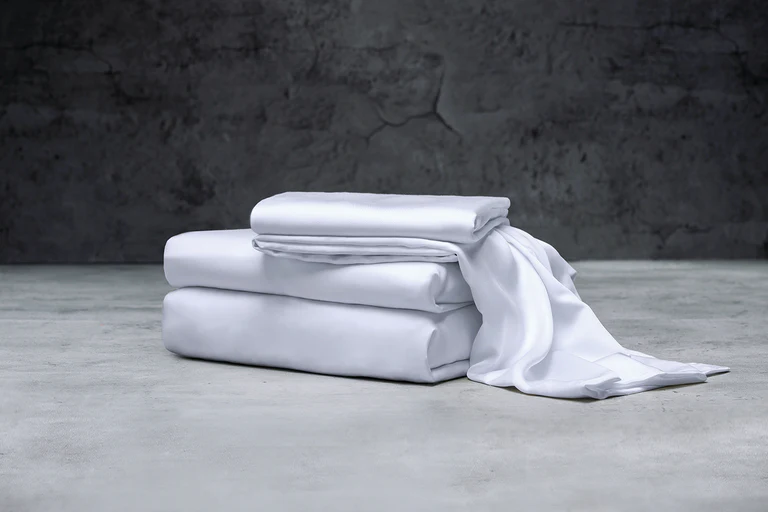
An American direct-to-consumer bedding brand built its launch around “luxurious 400-thread-count sheets.” First-month reviews glowed. By month three, the pilling started — first the fitted sheets, then everything. Returns spiked, and the lab test the founders finally commissioned told the story: the celebrated 400 thread count came from plied, low-twist yarns in a loose, under-finished construction — a number inflated on paper and fragile in the wash. Their bedding fabric suppliers had shipped exactly what the purchase order described. The brand had simply never learned to read the spec sheet hiding behind the thread count.
The numbers on a fabric specification sheet are not marketing copy. They are engineering — and every buyer who sources bedding fabric should be able to decode them. This guide, drawn from the technical practice of पूर्णता कपडा‘s production team, decodes the figures that determine how a fabric feels, धुन्छ, and lasts: thread count versus yarn count versus GSM, percale / वर्षा / twill weave mechanics, what mercerization and singeing really do, how finishes change hand feel and durability, and how to verify every claim in a lab before committing to bulk.
थ्रेड गणना, Yarn Count, and GSM: Three Numbers Buyers Keep Confusing
Ask ten buyers what thread count means and you will hear ten confident, slightly different answers. These three measurements describe completely different properties of a fabric, and confusing them is how inflated specifications survive unchallenged.
थ्रेड गणना: What It Counts — and How the Number Gets Inflated
Thread count is simply the number of warp plus weft yarns woven into one square inch of fabric. ए 133 x 72 construction, उदाहरण को लागी, genuinely contains about 205 threads per square inch. The inflation trick buyers must know about is multi-ply counting: a yarn twisted from two finer plies can be counted as two threads instead of one, so a true 200-thread fabric is marketed as “400TC.” Nothing about the fabric’s density, कोमलता, or durability changed — only the arithmetic. This is why two “400TC” sheetings from different mills can feel like entirely different products, and why experienced buyers treat thread count as a starting clue rather than a verdict. Always ask for the construction (ends x picks) behind the thread-count claim; a mill with nothing to hide provides it instantly.
Yarn Count: The Fineness Number That Predicts Hand Feel
Yarn count in the cotton system (Ne) measures fineness: the number of 840-yard hanks that weigh one pound. A higher number means a finer yarn — 60s is finer than 40s, which is finer than 30s. Finer yarns weave into denser, चिल्लो, more supple fabrics, and they cost more because spinning fine, even yarn demands better raw cotton and slower machines. For buyers selling into the US, look for long-staple or Egyptian-style cotton descriptions paired with the count: long staple spins into stronger, finer yarn with fewer protruding fiber ends, which is the real reason premium sheeting resists pilling. When a quotation lists only thread count without yarn count, you are missing the variable that most directly predicts how the fabric will feel against skin.
GSM: The Weight That Keeps Everyone Honest
GSM — grams per square meter — is the mill’s reality check. Two fabrics can both claim 200 thread count while weighing 115 GSM and 145 GSM respectively; the heavier one is genuinely denser, and density is what survives fifty wash cycles. GSM also exposes impossible combinations: if the stated construction and yarn count mathematically cannot produce the stated weight, something in the specification is wrong. Make GSM with a tolerance (उदाहरण को लागी 140 GSM +/- 5%) a mandatory line in every purchase contract, and have the bulk lot weighed on arrival. It is the cheapest verification test in textile sourcing.
Weave Mechanics: Why Percale, Sateen, and Twill Feel Nothing Alike
Weave is the architecture of the fabric — how each weft yarn interlaces with the warp — and it changes everything about hand feel, appearance, and durability even when the yarn is identical.
Percale is a plain 1/1 बुनाई: every weft yarn passes alternately over and under every warp yarn, creating the maximum number of interlacing points. The result is crisp, चिसो, and matte, with a clean breathable hand that suits warm climates and buyers who like a fresh, hotel-crisp feel. The trade-off is wrinkling — all those interlacing points resist draping — and a surface that shows no sheen.
Sateen uses a 4/1 (sometimes 3/1) interlacing: each weft yarn floats over four warp yarns before tucking under one. Those long floats create the lustrous, silky face and fluid drape buyers associate with luxury bedding, and the fabric feels warmer and smoother against skin. The cost of the beauty is exposure — long floats snag more easily and abrade faster, which is why sateen demands better yarn and proper finishing to survive commercial laundering. Most hotel satin-stripe fabrics are sateen-based dobby weaves, the stripe woven structurally rather than printed.
Twill interlaces in a stepped pattern that forms the familiar diagonal line. It sits between percale and sateen in character: more durable and drapeable than percale, less lustrous than sateen, with excellent resistance to showing soil — a practical reason twill appears in workwear-adjacent and high-rotation bedding. मा Nantong अखंडता कपडा, technicians match weave to end use before anything else: percale for crisp cool lines, sateen for luster and drape, twill where durability leads — because no finish can rescue a weave chosen wrong for its job.
Mercerization and Singeing: Two Steps That Change Everything
Two finishing processes separate premium bedding fabric from commodity cloth, and both are invisible in a photograph — which is why buyers must specify them in writing.
Singeing passes the fabric rapidly over open flame or heated plates, burning off the protruding surface fibers. The result is a clean, smooth face: less pilling in use, sharper printed patterns, and a better foundation for every finish that follows. Unsinged fabric may look identical on the roll but grows fuzzy within weeks of washing, and that fuzz is what customers describe as “going cheap.”
Mercerization treats the cotton with caustic soda under tension. The fibers swell and their cross-section rounds out, delivering four measurable gains: higher tensile strength, a natural luster that does not wash out, significantly better dye uptake (deeper shades with better fastness), and improved dimensional stability. Both processes add cost — energy, chemistry, machine time — so budget quotations quietly omit them. If your specification does not say “singed and mercerized,” assume you are being quoted the version that is neither.
How Finishes Change Hand Feel, स्थायित्व, and Care
Beyond singeing and mercerizing, a series of chemical and mechanical finishes fine-tunes the fabric. Each is a trade-off worth understanding.
Softeners come in two broad families. Silicone softeners coat fibers with a slick film that survives many washes — the “buttery” hand of premium sheeting. Cationic and fatty softeners feel soft initially but wash out faster. If your product promises lasting softness, specify the softener family, not just “soft finish.” Easy-care resins crosslink fibers to fight wrinkling; insist on formaldehyde-free formulations for sensitive markets and accept the slight trade-off in strength and breathability. Pre-shrinking (sanforizing) locks in dimensions — bedding that shrinks more than a few percent generates returns no margin can absorb, so state a maximum shrinkage percentage in the contract. Enzyme bio-polishing digests surface fuzz for an anti-pilling hand, and mechanical brushing raises a fine nap for flannel lines. Match the finish list to the promise on the packaging.
Verifying Specs in the Lab Before You Commit
Every claim on a spec sheet is verifiable, and professional buyers verify before bulk — not after the container lands. Commission testing at an internationally recognized third-party laboratory and require the report before approving production.
The core test panel for bedding fabric covers composition (is it really 100% कपास, or a undisclosed blend?), yarn count, थ्रेड गणना, and GSM — the four numbers that define what you are buying. Performance testing follows: colorfastness to washing, रगड्दै, light, and perspiration, each graded against the standard your market requires; pilling resistance; and dimensional stability after repeated wash cycles. Chemical safety rounds it out: formaldehyde content and pH, particularly for easy-care finished goods. As a baseline product-safety credential, look for OEKO-TEX Standard 100 certification on the finished fabric, which screens for harmful substances — it is the certification most retail buyers recognize and the one our factory holds across its bedding fabric program alongside ISO9001, ISO14001, and ISO45001.
Testing discipline extends into production. Approve lab dips for color and strike-offs for print before bulk begins, seal a bulk approval sample signed by both sides, and inspect the shipment against that sealed sample — not against your memory of it. A specification verified in the lab and locked with a sealed sample is the closest thing sourcing has to a guarantee.
बारम्बार सोधिने प्रश्नहरू
Is a higher thread count always better?
छैन. Thread count measures quantity of yarns, not their quality. A honestly constructed 200-thread percale from fine long-staple 60s yarn will out-feel and out-last an inflated “600TC” woven from coarse plied yarns. Judge the construction, yarn count, and finishing first; treat thread count as a secondary descriptor.
Percale or sateen — which should my bedding line carry?
Carry the one that matches your brand promise. Percale delivers crisp, चिसो, matte freshness and suits warm-sleep positioning; sateen delivers luster, drape, and a silky hand for luxury positioning. Many successful lines carry both and let the customer choose — but never blend the two stories in one product description.
How can I tell whether a fabric is truly mercerized?
Ask for the process declaration in writing and verify with a lab: mercerized cotton shows higher luster, greater strength, and deeper dye uptake than its unmercerized twin. A simple field check is the dye test — mercerized fabric takes color more deeply and evenly — but a laboratory report on luster and barium activity value is definitive.
Why do two mills’ 40s cotton fabrics feel so different?
Because yarn count is only one variable. The cotton staple length, बुनाई, whether the fabric was singed and mercerized, and the softener recipe all shape hand feel as much as the count does. This is exactly why spec sheets must be read whole — a single number never tells the story.
Which tests matter most for hotel bedding?
Prioritize dimensional stability (hotels wash hot and often), colorfastness to washing and light, pilling resistance, and tensile strength after repeated laundering. Hotel programs live or die on how the fabric looks at wash fifty, not wash one — specify the test, the method, and the minimum grade in the contract.
Read the Sheet, Then Choose the Mill
A buyer who can decode a spec sheet negotiates from knowledge instead of hope: you will spot inflated thread counts, price the finishes you actually need, and hold every supplier to the same measurable standard. That competence compounds — mills quote their best work to buyers who can tell the difference.
If you want a technical partner to walk through a specification with you — or to engineer a construction against your target hand feel and price — हामीलाई सम्पर्क गर्नुहोस् at Nantong Integrity Textile. Our team in Tongzhou District, Nantong has woven and finished mid-to-high-end bedding fabrics since 2007, working from a 30,000-square-meter facility certified to ISO9001, ISO14001, ISO45001 र OEKO-TEX मानक 100, and we will decode any spec sheet with you line by line. Email Alex@integritytex.com, Whatsapp +86 151 5289 1159, or visit www.integritytex.com.