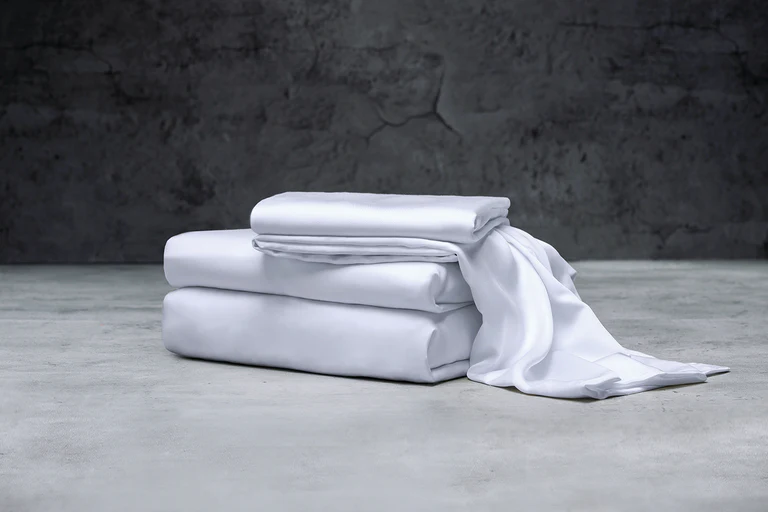
Your hotel group is opening twelve properties across three countries next year. The brand standard calls for crisp white bedding with the property logo embroidered on the duvet cuff, a specific sateen stripe the design team fell in love with, and sheets that survive commercial laundry twice a week for years. You send the spec to three manufacturers. One quotes a price with no questions. One asks for your laundry temperature. One asks for your laundry temperature, your par levels, your embroidery file, and your rollout schedule, then sends a project timeline. Only one of them has ever customized hotel bedding before.
Hotel bedding customization is a project, not a purchase. It runs from spec definition through sampling, sulaman, color matching, pembungkusan, and a phased rollout, and each step has failure modes that only show up months later in a laundry room or a guest review. This guide walks the full process step by step, shows you what good looks like at each stage, and gives you the questions that reveal whether a manufacturer can actually deliver a multi-property program or is just quoting one.
Langkah 1: Spec Definition, Where Programs Are Won or Lost
Everything downstream depends on the specification document, and most of them are dangerously vague. “White sateen sheets, hotel quality” is not a spec; it is a wish. A working spec names the weave and thread count, the exact dimensions for each bed size in your properties, the hem style and depth, the elastic specification for fitted sheets, the fiber content, and the performance requirements: minimum tensile strength, maximum shrinkage, pilling grade after a defined number of wash cycles. If your properties run commercial laundries, the spec must state the wash temperature, chemistry, and expected laundry cycles per week, because a sheet engineered for home washing dies young in a 75-degree commercial tunnel washer.
Thread count deserves a frank conversation. Hotel programs often specify 300TC or 400TC because the numbers sound premium, but commercial laundry longevity depends more on yarn quality, weave balance, and finishing than on the count alone. A well-made 250TC percale with long-staple yarn outlasts a loosely woven 400TC sateen in commercial service, and costs less to replace. Tell your manufacturer your real operating conditions and let them engineer to the outcome, whiteness retention and service life, rather than to a number on a hangtag.
This is also where you define the range: which items, which sizes, which properties get what. A twelve-property rollout might need king, permaisuri, and twin across sheets, sarung selimut, sarung bantal, skirt katil, and blankets, each in exact counts per property. Build the full matrix now. Manufacturers price and plan from this matrix, and every item added later restarts part of the sampling clock. Hotel bedding manufacturers experienced in programs will help you build this matrix in the first meeting; inexperienced ones will quote the three items you mentioned and discover the rest during production.
Langkah 2: Persampelan, the Cheap Place to Find Expensive Mistakes
Sampling runs in rounds, and each round has a job. Round one is the construction sample: undyed or stock-white, proving dimensions, hems, elastic, and workmanship against your spec. Do not approve aesthetics on round one; approve engineering. Measure everything. Wash it in your actual laundry process if possible, because lab washing and your tunnel washer are different machines with different opinions.
Round two is the pre-production sample in your exact fabric, warna, and trims, with embroidery if your program includes it. This is the sample your brand team signs, secara literal. Photograph it under your property lighting, because showroom lighting lies about white. Check the embroidery density and backing: hotel embroidery must survive hundreds of commercial washes without puckering or thread breakage, which means denser stitching and proper stabilizer, not the light embroidery used on retail gift sets.
Approve in writing with the sample sealed and retained by both sides. The sealed sample is the physical contract: bulk production is judged against it, not against anyone’s memory of a video call. Note the approval date, because fabric dye lots drift over time and the approval anchors which lot standard you accepted. A manufacturer like Tekstil Integriti Nantong runs this discipline as routine, since our OEM programs live or die on sample-to-bulk fidelity.
Langkah 3: Embroidery and Branding That Survives the Laundry
Hotel embroidery fails in predictable ways, and all of them are preventable at the digitizing stage. Puckering around the design means the stabilizer was wrong for the fabric or the density was too high for a lightweight sheeting. Thread breaks in laundry mean the thread was not rated for commercial wash temperatures, or the design had too many trim jumps that became weak points. Fading means the thread was not colorfast to your laundry chemistry. Each failure traces to a specification choice, which is why the embroidery spec belongs in the main spec document, not in an email to the embroidery department.
Placement and scale need brand-team sign-off on physical samples, not screen renders. A logo that looks elegant at 10 centimeters on a screen can look lost or loud on a king duvet cuff in a real suite. Produce placement samples on the actual product, photograph them on a made bed, and circulate those photos for approval. This feels slow; it is the fastest way, because re-digitizing after bulk production starts is not an option anyone wants.
Consider the laundry’s perspective on every branding decision. Woven labels sewn into hems can irritate guests and catch in laundry equipment; printed care and brand marks inside the hem are often the better choice for sheets. Embroidery on pillowcase cuffs sees less abrasion than embroidery on duvet edges that get gripped and pulled daily. Design branding for the item’s hardest day, not its photo shoot.
Langkah 4: The White Problem, Color Matching Across Lots and Years
White is not one color. Optical white, natural white, and bleached white are visibly different side by side, and your twelve properties will notice if the Shanghai sheets are bluer than the Dubai sheets. Define your white with a standard: a physical swatch, a spectrophotometer reading, atau kedua-duanya. The factory’s dye lab matches to that standard on every lot, and your QC checks incoming lots against it. Without a defined standard, “putih” drifts with every dye lot, and drift becomes visible exactly when a property mixes old and new stock on the same bed.
The harder problem is time. A program running for years will reorder against fabric lots dyed years apart, and even good dyehouses drift. Build lot-to-lot tolerance into your spec and require the factory to retain your standard swatch, stored away from light. For large programs, some buyers hold a sealed reference set from the original bulk run and require each reorder’s lab dip to be approved against it before dyeing. This adds a week to reorders and saves the slow-motion brand damage of twelve properties in twelve slightly different whites.
Whiteness retention in service is the other half. Specify the finishing: the anti-yellowing and soil-release finishes that keep white sheets looking white through commercial laundering. Then verify with wash testing, not with the finish supplier’s data sheet. Wash your pre-production sample through fifty cycles in your actual laundry conditions and compare against the unwashed sealed sample. The gap you see is the gap your guests will see in year two.
Langkah 5: Packaging and Logistics for Multi-Property Rollouts
Hotel programs do not ship to one warehouse; they ship to twelve loading docks on different continents, often on different dates tied to opening schedules. Packaging must carry property identification: carton markings with property name, item, saiz, and quantity, so a dock worker in any country can route cartons without opening them. Mixed-property containers need a loading plan that maps carton sequences to unloading order. This is logistics project management, and it belongs in the manufacturer’s scope, not left to your forwarder to improvise.
Par-level math drives order quantities. A 200-room property running 3 pars of sheets needs 600 sheet sets per bed size in circulation, plus the opening order often includes extra for the pre-opening burn-in period when laundry processes are still being tuned. Your manufacturer should sanity-check your quantities against your par policy and flag anomalies; a factory that just multiplies rooms by three without asking about pars is not thinking about your operation.
Phased delivery needs production scheduling to match. Properties opening in March, July, and November should not all receive goods in February, tying up your cash in warehouse storage and risking moisture damage in long storage. A program manufacturer staggers production to your opening calendar, holds finished goods in proper warehouse conditions between phases, and ships against your schedule. Confirm storage conditions and who bears the risk during the hold period. Kilang kami plans program rollouts around opening dates, because bedding delivered six months early is a storage problem, not a head start.
Langkah 6: Launch Support and the Long Tail of Replenishment
The program does not end at delivery. Opening weeks surface issues no sample caught: a fitted sheet that fights the housekeeping team on deep mattresses, a duvet cover closure that slows room turnover. Build a feedback window into the program, typically the first sixty days per property, with a clear channel for property-level issues and a commitment on response time. Small fixes early, a hem depth adjustment, a closure change, propagate into the replenishment spec and compound across the program’s life.
Replenishment is where programs quietly die. Two years in, the original fabric lot is gone, the embroidery digitizer left the factory, and the reorder comes back subtly wrong. Prevent this with program documentation: the full spec, the sealed approved samples, the embroidery files, the dye standard, the packaging marks, all retained by the factory under your program name. When you reorder, the factory pulls the program file, not someone’s memory. Ask prospective manufacturers how they archive program specifications; the good ones show you a system, the bad ones show you a filing cabinet of good intentions.
Akhirnya, plan the economics of the long tail. Replenishment orders are smaller than opening orders and will carry different pricing; agree on the replenishment price structure during the initial negotiation, not when you are desperate for 200 replacement pillowcases. A manufacturer invested in your program’s lifetime will offer sensible replenishment terms, because they understand the opening order was the beginning of revenue, not the whole of it.
Soalan Lazim
How long does a custom hotel bedding program take from spec to delivery?
Typically twelve to twenty weeks depending on complexity: two to four weeks for spec and sampling rounds, one to two weeks for embroidery digitizing and approval, four to six weeks for bulk production, and four to eight weeks for ocean freight. Custom dye colors and complex embroidery add time. Start the clock from your latest property opening and work backward, then add a buffer.
What thread count should I specify for hotel sheets in commercial laundry?
Focus on yarn quality, menganyam, and finishing rather than chasing a number. A well-constructed 250TC percale with good yarn often outlasts a loosely woven 400TC sateen in commercial service. Specify performance requirements, shrinkage limits, kekuatan tegangan, whiteness retention after defined wash cycles, and let the construction serve those outcomes.
How do I keep white bedding consistent across multiple properties and reorders?
Define your white with a physical swatch or spectrophotometer standard, require lot-to-lot matching against it, and retain a sealed reference set from the original bulk run for approving future dye lots. Specify anti-yellowing finishes and verify with real wash testing through fifty cycles in your actual laundry conditions.
What embroidery specifications matter for hotel bedding durability?
Thread rated for your commercial wash temperature and chemistry, proper stabilizer for the fabric weight, density balanced to avoid puckering, and minimal trim jumps that become weak points. Approve placement and scale on physical samples photographed on a made bed, and design branding for the item’s hardest laundry day.
How should multi-property orders be packaged and shipped?
Cartons marked with property name, item, saiz, and quantity for dock-level routing, mixed-property containers loaded to a plan matching unloading order, and production staggered to your opening calendar rather than delivered all at once. Confirm finished-goods storage conditions and risk responsibility for goods held between phases.
What documentation should the factory retain for future replenishment?
The complete spec document, sealed approved samples, embroidery digitizing files, the dye and whiteness standard, packaging and marking specs, and the par-level quantity matrix, all filed under your program name. Agree on replenishment pricing structure during initial negotiation. Without this archive, reorders drift and the program degrades lot by lot.
Run Your Program Like the Project It Is
Custom hotel bedding rewards buyers who manage it as a project: a real spec, disciplined sampling, laundry-rated embroidery, a defined white, property-level logistics, and documentation that outlives personnel changes on both sides. The manufacturers who thrive in this work are the ones who ask about your laundry temperature in the first meeting. Choose the one who asked the most questions, not the one who quoted the fastest.
TEKSTIL INTEGRITI runs custom hotel bedding programs from our Nantong factory, with in-house sampling, laundry-rated embroidery, dye-lot whiteness control, and phased multi-property rollout logistics. To scope your program, hubungi kami di Alex@integritytex.com atau WhatsApp +86 151 5289 1159. Bring us your property count, your opening calendar, and your laundry reality, and we will build the timeline and the spec with you.