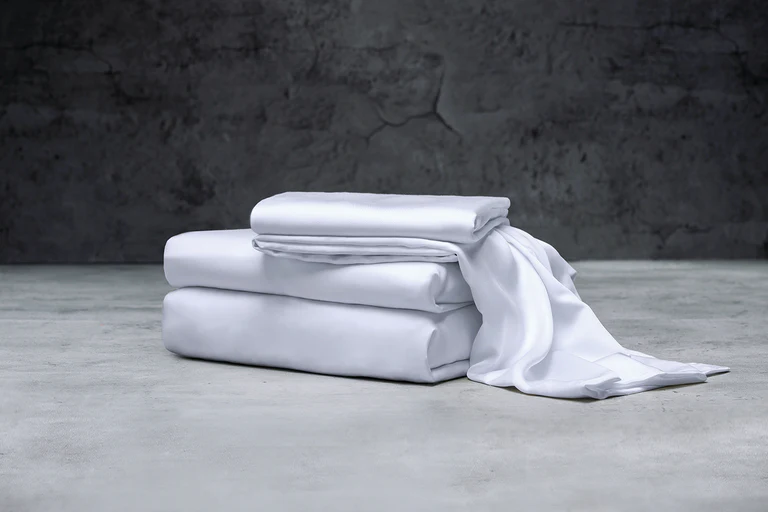
Last spring, the buying director of a mid-sized Scandinavian home-textiles brand called us with a problem we see almost every year. She had developed a custom dobby stripe for a new sheet program with a mill she had never worked with before. To save three weeks, she approved bulk production straight from a lab dip — no pilot run, no sealed greige standard. Thirty thousand meters arrived six weeks later, and the shade drifted visibly from roll to roll. The first and last rolls of the same production lot looked like two different colorways. Her spring launch missed its window, the retailer charged her a late-delivery penalty, and roughly €140,000 of planned revenue evaporated. The fabric itself was fine. The development process was not.
This is the uncomfortable truth about working with bed sheet fabric manufacturers: the fabric you receive is only as good as the development discipline that preceded it. Buyers obsess over price per meter, but the expensive mistakes almost never happen at the price line. They happen at the gates buyers skip — the feasibility review nobody documented, the lab dip approved under office lighting, the pilot run everyone agreed was “probably unnecessary.” A disciplined development process does not slow you down. It is the only thing that keeps a 20,000-meter commitment from becoming a 20,000-meter problem.
Why Fabric Development Is Its Own Discipline
Ordering stock fabric and developing custom fabric are two completely different sports. With stock fabric, the manufacturer has already absorbed every risk: the weave is proven, the dye recipe is locked, the shrinkage behavior is known. With development, you and the mill are jointly inventing a product that has never existed at scale. The greige construction you sketched, the hand feel you described as “buttery but crisp,” the exact shade of sage in your mood board — none of these exist yet as a repeatable industrial outcome. Development is the process of converting a buyer’s idea into a factory’s repeatable recipe, and every gate in that process exists because someone, somewhere, lost serious money by skipping it.
Professional bed sheet fabric manufacturers think in gates, not in vibes. Each gate has a clear question, a physical sample that answers it, and a sign-off that locks the answer in. When a mill tells you “no problem, we can do it” without asking for your shade standard, your wash-test requirement, or your target price, that is not confidence — that is a missing process. The rest of this article walks through the five gates of a professional development process, what each one costs in time, who pays for it, and how to know when to walk away.
Gate 1: The Brief — Garbage In, Shade Drift Out
Every failed development we have ever seen can be traced back to a vague brief. “Something like the attached photo, in a nice sage green, yumshoq qo'l hissi, good quality” is not a brief — it is a wish. A manufacturer cannot develop against a wish. A professional development brief for bed sheet fabric contains, at minimum, the fiber and blend, the yarn count and construction target, the finished width, the weight range, the color standard (a physical swatch or a Pantone TCX reference, never a phone photo), the hand-feel reference (an existing fabric the buyer likes), the performance requirements (shrinkage tolerance, colorfastness grade, pilling grade), the intended end use, the estimated annual volume, and the target price.
The target price deserves special attention. Many buyers hide it, fearing the mill will simply quote exactly that number. In our experience, the opposite happens: without a target, the mill develops toward its own default cost structure, and you discover the mismatch after three rounds of sampling. Our factory works on a respect target price model — you name one target price, and we answer yes or no. If the answer is yes, the development is engineered toward that number from day one: the construction, the dyeing route, and the finishing are all chosen to hit your price honestly, not to be value-engineered downward later. A brief without a target price is a development without a destination.
Gate 2: Feasibility and Development Costing — Who Pays for the Experiment
Once the brief lands, a serious manufacturer runs a feasibility review before cutting a single meter of greige. Can the requested construction run on the mill’s looms? Does the dyehouse handle that fiber blend at that shade depth? Is the finishing you want — say, a soft peach finish on long-staple cotton sateen — compatible with the OEKO-TEX Standard 100 certification you require? This review typically takes three to five working days, and the honest answer is sometimes “not exactly as specified, but here is the closest achievable version.” A mill that never pushes back on a brief is a mill that is not really reading it.
Then comes the question buyers are often embarrassed to ask: who pays for development? Industry practice varies, but the common patterns are worth knowing. Many established mills develop free of charge for qualified buyers, absorbing sampling cost against expected bulk volume. Others charge a development fee — typically covering greige, bo'yash, and lab work — that is credited back against the first bulk order. What you should never accept is a large upfront “development deposit” with no written credit terms, and you should always clarify who owns the strike-offs and screens if you walk away. When you develop with an experienced producer like INTEGRITY TEXTILE, the development conversation happens in writing before sampling starts: timelines per gate, cost responsibility, and what happens to your exclusive artwork if the project does not proceed.
Gate 3: Greige, Lab Dips, and Strike-Offs — Where Color Is Won or Lost
The greige trial is the first physical proof that your construction exists. Before any color is applied, the mill weaves a short run of the undyed fabric so both sides can verify the hand feel, the drape, the width, and the weight. Approve the greige on its own merits — never approve greige and color in the same round, because a dye problem will mask a construction problem and you will end up re-developing both. A greige approval typically takes one to two weeks including shipping, and it is the cheapest gate in the entire process. Skipping it to save ten days is the false economy that created our Scandinavian friend’s €140,000 lesson.
Lab dips are where most color disputes are born. A lab dip is a small dyed swatch produced in the laboratory to match your shade standard — it is a promise, not a product. The critical discipline is how you evaluate it. Never approve a lab dip under office fluorescent lighting or from a phone photo. Evaluate it in a lightbox under D65 daylight, next to your physical standard, and check it under at least two light sources for metamerism — the phenomenon where two shades match under one light and clash under another. For bed sheet programs sold under warm bedroom lighting, this check is non-negotiable. Ask the mill how many lab-dip rounds are included before surcharges apply; three rounds is a common professional standard, and a mill that nails it in one round every time is either exceptional or not really matching.
Bosilgan matolar uchun, the equivalent gate is the strike-off: a short printed sample of your actual design. Check registration, color separation, print clarity at the repeat, and — critically — the strike-off against the lab dip, because print paste and piece dyeing are different chemistries that rarely produce identical shades. Nantong Integrity Textile develops prints against a sealed strike-off standard precisely because “close enough on screen” has destroyed more launches than any other phrase in textile sourcing.
Gate 4: The Pilot Run — The Gate Everyone Wants to Skip
The pilot run — sometimes called the bulk trial or pre-production run — is a short production-length run, typically a few hundred meters, executed on the actual production line with production chemistry. It answers the one question no lab sample can: does this fabric behave the same at 500 meters as it did at 5 metr? Shade continuity across the roll, width consistency, shrinkage after the production finishing route, and hand feel after full-width processing can all shift between lab and line. The pilot run is where you discover it, while the exposure is still a few hundred meters instead of a few ten-thousands.
Measure the pilot run ruthlessly. Cut swatches from the head, o'rtada, and tail of the roll and compare them side by side under D65. Wash-test per your care-label standard and measure shrinkage against your tolerance — for fitted sheets, even a one-percent surprise in the weft direction becomes a customer complaint about sheets popping off corners. Check the finished width at multiple points; a width that wanders by three centimeters will wander through your cutting markers too. Only when the pilot run meets every line of the brief does the project advance. At bizning fabrikamiz, no bulk production starts without a signed pilot-run approval, because the signature is what turns “we thought it was fine” into “we verified it was fine.”
Gate 5: Bulk Approval and the Sealed Standard
Bulk production begins only after the pilot run is approved — and the approval must be physical, not verbal. The professional instrument is the sealed standard: a set of approved swatches (greige, lab dip or strike-off, and pilot-run cutting), each signed and dated by both buyer and mill, with one set held by each party. Every bulk shipment is then judged against the sealed standard, not against anyone’s memory of what was agreed. When a shade dispute arises six months later — and in long programs it will — the sealed swatch ends the argument in minutes instead of emails.
Agree the bulk inspection protocol before the first container, not after a problem. Will inspection be the mill’s internal QC plus your third-party inspector, or will you rely on the mill’s reports? What is the acceptable quality level for critical, mayor, and minor defects? What happens to rolls that fail — re-dye, downgrade, or reject? Nantong Integrity Textile Co., Ltd., founded in 2007 Tongzhou tumanida, Nantong, operates its sheeting programs under documented inspection standards backed by ISO9001, ISO14001, ISO45001, va OEKO-TEX standarti 100 sertifikatlash, with roughly 143 staff across some 30,000 square meters of production space and monthly capacity of about 40,000 choyshablar va 25,000 dubet qopqog'ini qoplaydi. Scale matters at this gate: a mill with real bulk capacity does not need to squeeze your 20,000 meters through an overloaded dyehouse, which is where most shade-drift disasters actually originate.
Protecting Your Exclusive Print or Weave
Custom development creates intellectual property, and sloppy mills treat it casually. If your dobby stripe, jakkard, or print is exclusive to your brand, say so in writing before the first strike-off — not after you spot a suspiciously similar fabric at a trade show. A professional development agreement covers three points: the artwork and screens remain your property, the mill will not produce the design for other buyers, and the exclusivity has a defined scope (by market, by channel, or worldwide) and duration. Get the mill’s confirmation in the same email thread as the brief, so the commitment is timestamped alongside the technical specification. Reputable bed sheet fabric manufacturers expect this conversation; a mill that gets evasive about exclusivity is telling you everything you need to know.
When to Walk Away: Five Red Flags in Development
Not every development deserves to reach bulk. Walk away — or at least pause — when you see these signals. Birinchidan, the mill approves its own samples without asking for your sign-off at each gate; that is not efficiency, it is a mill deciding your quality standard for you. Ikkinchi, lab dips keep coming back “close” but never exact after four or more rounds; the dyehouse likely lacks the right fiber expertise for your shade depth. Uchinchi, timelines slip at every gate with vague explanations; development delays compound, and a mill that cannot hold a sampling schedule will not hold a bulk schedule. Fourth, the mill resists the pilot run or the sealed standard; there is no legitimate technical reason to refuse either. Fifth, costing keeps creeping upward between gates without a documented specification change; that is margin recovery disguised as development.
Walking away at gate two or three costs you weeks. Walking away after a failed 30,000-meter bulk costs you a season. The development process is, eng avvalo, a cheap way to discover expensive truths early.
Tez-tez so'raladigan savollar
How long does a full fabric development cycle take with bed sheet fabric manufacturers?
For a solid-dyed sheeting fabric, plan six to ten weeks from brief to bulk-ready: one week for feasibility, one to two weeks for greige, two to three weeks for lab dips including shipping and evaluation rounds, one to two weeks for the pilot run, and final sign-off. Printed designs add one to two weeks for strike-offs and screen engraving. Build buffer into your calendar — development that is rushed at the lab-dip gate almost always pays the time back with interest at the bulk gate.
Should I pay a development fee, or should sampling be free?
Both models are legitimate. Established mills often sample free for qualified buyers with real bulk intent, while development fees credited against the first bulk order are standard for complex prints or unusual constructions. What matters is that the terms are written down before sampling: what the fee covers, when it is credited back, and who owns the artwork if you do not proceed. Be wary of large non-creditable upfront deposits.
How many lab-dip rounds are normal before approval?
Two to three rounds is typical for solid shades. One-round approvals happen with straightforward colors on familiar fiber blends; four or more rounds suggest either a genuinely difficult shade — deep navy and true black on cotton are classic troublemakers — or a dyehouse that is guessing. If you are past round four with no convergence, ask for a technical review meeting rather than another dip.
Can I approve lab dips from photos to save time?
For early rounds, photos can keep momentum. For final approval, no. Cameras and screens lie about shade, and metamerism is invisible in a photograph. Final lab-dip and strike-off approvals should always be against physical swatches evaluated under D65 lighting next to your standard. The shipping cost of a swatch envelope is the cheapest insurance in the entire development budget.
What should a development brief include that buyers most often forget?
Three things: the target price, the wash and performance test standard with numeric tolerances, and the exclusivity terms for the design. Buyers remember fiber, rang, and hand feel; they forget the commercial and legal frame that determines whether the development can actually become a product. A complete brief also states estimated annual volume, because a mill engineers differently for 5,000 meters a year versus 200,000.
Develop It Right, Once
The Scandinavian buyer from our opening story re-ran her dobby stripe the following season — this time through all five gates, with a sealed standard and a signed pilot run. The bulk matched. The launch landed on time. The development took eleven weeks instead of eight, and she will tell you those three extra weeks were the cheapest insurance she ever bought. Custom fabric development with bed sheet fabric manufacturers is not complicated, but it is unforgiving of shortcuts: brief it completely, gate it honestly, pilot it always, and seal it in writing.
If you are planning a custom sheeting program — a new weave, an exclusive print, a shade your current mill cannot hit — Biz bilan bog'lanish with your brief, your target price, and your timeline. We will run the feasibility review, lay out the five gates with dates, and give you a straight yes-or-no on your target price before a single meter is woven. Reach us at Alex@integritytex.com or WhatsApp +86 151 5289 1159, or start at www.integritytex.com.